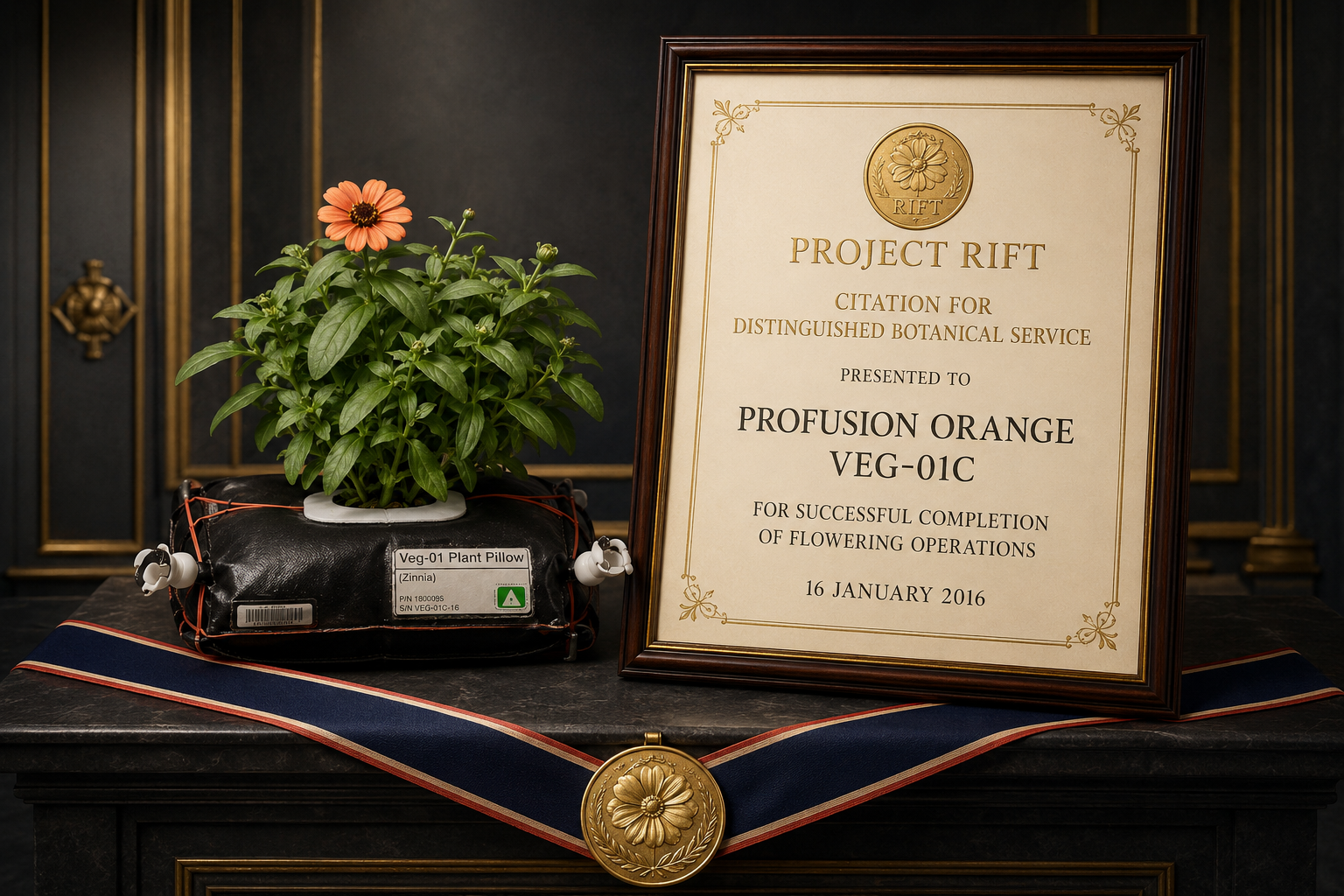
There are gardening problems, and then there are gardening problems that occur while the garden is traveling roughly 250 miles above Earth at several miles per second.
In November 2015, NASA began growing zinnias aboard the International Space Station. The flowers were part of VEG-01, an experiment using the Vegetable Production System—mercifully shortened to Veggie. The zinnias were not sent up merely because the station needed seasonal color. They were a test of whether astronauts could manage a longer-lived, flowering crop in microgravity before NASA moved on to plants expected to produce food, such as tomatoes and peppers.
The project had lights. It had rooting pillows. It had nutrient delivery, watering instructions, ground support, cameras, scientists, astronauts, and an orbiting laboratory built through international cooperation at extraordinary expense.
It also had a fan that did not come back on.
The flowers were not looking too good
Astronaut Kjell Lindgren activated the zinnia experiment on November 16, 2015. The plants began growing in individual fabric plant pillows inside Veggie. According to a later NASA account by project scientist Gioia Massa, a power interruption occurred during the experiment. When power returned, the lights and indicators came back—but the fans did not. The problem was not immediately obvious from Earth.
Without the expected airflow, the plants remained too wet. They became stressed and began producing abnormal growth. Then fungus appeared.
On December 22, the station's official daily report recorded a "Veg-01 Anomaly." Scott Kelly had noticed an unexpected growth and sent photographs to specialists on the ground. Working with them, he removed affected plant material, sealed it in two bags, and put it into the station's minus-eighty-degree laboratory freezer for return to Earth. He also increased the Veggie fan speed to address the excess moisture.
Some plants died. The remaining zinnias did not look ready for a commemorative postage stamp.
Kelly summarized the situation more efficiently on December 27: the space flowers "aren't looking too good." He said he might have to channel his inner Mark Watney, the stranded astronaut-farmer from The Martian.
This was funny because it was true, although the crop involved was ornamental and the gardener had considerably more ground support.
Mission control encounters gardening
The deeper problem was not simply mold. It was the distance between a living plant and a procedure written for it.
Ground teams had been directing watering according to a schedule. Kelly, however, could see the zinnias. He told the team that future crews traveling to Mars would have to decide for themselves when their crops needed water, much as a person on Earth looks at a lawn and decides whether it is dry.
This was a small declaration of agricultural independence.
NASA agreed. The Veggie team replaced the usual highly detailed operational instructions with a one-page document carrying the magnificent title Zinnia Care Guide for the On-Orbit Gardener. The guide established basic limits while giving Kelly discretion to evaluate the plants in front of him.
The title sounds as if it should have been issued by Project RIFT. It was not. It was issued by the United States space program because the United States space program had developed a zinnia problem.
The change mattered. Kelly cleaned the surviving plants, restored airflow, and began watering according to their condition rather than waiting for Earth to prescribe each intervention. By January 8, he reported that the zinnias were recovering. On January 12, photographs showed petals beginning to emerge. On January 16, an orange flower opened aboard the station.
The plants had survived hardware trouble, excess moisture, fungal growth, pruning, quarantine, and a transfer of horticultural authority.
In other words, they had experienced a fairly serious gardening season.
A note concerning the first flower in space
The orange zinnia is often described as the first flower ever grown in space. That claim is too broad. Plants had flowered in earlier space experiments, and astronaut Don Pettit had even grown a sunflower aboard the International Space Station in 2012.
NASA's more careful headline identifies the zinnia as the first flower grown in the space station's Veggie facility. That distinction does not make the experiment less interesting. Its importance was not botanical priority. It was the deliberate testing of a demanding flowering crop inside a system intended to help astronauts grow fresh food on long missions.
Zinnias were useful precisely because they were harder than lettuce. They grew longer, responded more sensitively to environmental conditions and light, and had to progress into flowering. If a crew could manage them, NASA would learn something useful before asking the same equipment and the same humans to produce tomatoes or peppers.
The garden was part of the crew
The experiment also revealed something NASA already suspected: plants in space are not only potential food.
Long-duration spaceflight limits the ordinary sensory experiences of Earth. There is no breeze, rain on a roof, outdoor soil, or changing landscape. NASA's Human Research Program has studied whether tending plants can help with monotony, isolation, and stress. Astronauts have repeatedly described plant care as meaningful work and a connection to life beyond the machinery surrounding them.
Kelly's response to the zinnias was not emotionally neutral. He worried when they declined, celebrated when they recovered, photographed the first bloom, and later arranged the surviving flowers into a small floating bouquet. NASA records that the bouquet was photographed in the station's cupola against Earth.
The zinnias were experimental subjects. They were also, unmistakably, somebody's plants.
Findings
The official success was not that every zinnia lived. They did not. Nor was it that NASA had designed a system incapable of ordinary horticultural failure. It had not.
The useful result was that the failure exposed several things at once: flowering plants were sensitive to moisture and airflow; equipment status could be misunderstood from the ground; fungal problems had to be handled safely; and a crew on a distant mission could not garden effectively if every judgment required permission from another planet.
NASA began with scheduled care directed from Earth. It ended with an astronaut examining the plants, making decisions, and working within a one-page guide.
The bureaucracy did not disappear. It became shorter and gave the gardener authority.
That may be the most successful possible outcome of a zinnia problem.
Sources and further reading
- NASA — First Flower Grown in Space Station's Veggie Facility
- NASA — Zinnias from Space! NASA Studies the Multiple Benefits of Gardening
- NASA — ISS Daily Summary Report, December 22, 2015
- NASA — How to Grow Plants in Space (Curious Universe transcript)
- NASA — Growing Plants in Space
- NASA — VEGGIE: Vegetable Production System
- NASA Technical Reports Server — Veggie: Space Vegetables for the ISS and Beyond
- Space.com / collectSPACE — First Flower Grown in Space (Or Not)
Reader filing desk
Supplemental Notes
Have relevant evidence, a correction, botanical context, or another useful observation? File an additional note for review. This is not an open comment thread; nothing appears publicly unless Project RIFT accepts it as a Filed Addendum.